

THE COMPLETE CHART
The Periodic Table of Marks
A FIELD GUIDE TO PUNCTUATION, CHARTED
About the chart
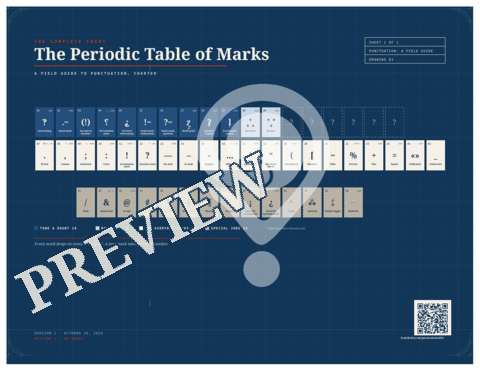
Every specimen in the guide, numbered and seated with its family. Tap a cell to open its card. New marks take the next number and a seat of their own.



TONE & DOUBT 10REASONING 2THE EVERYDAY MARKS 20SPECIAL JOBS 14
* Year of earliest known use.
Play the hunt to unlock free posters
Find all 8 hidden interrobangs to unlock the downloads.
Play the hunt →See the free posters & wallpapers
Find all eight to unlock
- Print-ready PDFA printable PDF of the complete chart.
- Desktop wallpaperThe chart sized for a computer screen.
- Phone wallpaperA tall version for your phone.
- Letter-size printA vector file for letter-size printing.
- 24 × 18 printA vector file for a larger wall poster.
- Print spec sheetPaper, sizing and print setup notes.
- Vector posterThe master SVG, sharp at any size.
 Print-ready PDF
All eight found. Your free downloads are ready.
Teaching a class? Get the free Educators kit. No hunt required.
Why we built the chart this way
Mendeleev left empty seats for elements nobody had found yet. This chart works the same way. Every mark gets a permanent number the day it joins the guide, and numbers never change: No. 01 is the Interrobang, because of course it is. The first six match the shirt series, since the shirts and the chart catalog the same specimens. Families group marks by the job they do: tone and doubt, reasoning, the everyday workhorses, special jobs. A new mark does not squeeze in anywhere it fits; it takes the next number and its family's table grows a new seat. Others have charted punctuation before (Curtis Newbold's 2016 poster put 14 common marks in element boxes). This one keeps going: every mark, including the obscure, the proposed and the nearly forgotten, each one clickable to its card, each with its story and its voice, and room for the marks nobody has found yet.